
Forum Replies Created
-
AuthorPosts
-
October 21, 2017 at 12:12 pm in reply to: Participate in the October 2017 Member Challenge – Halloween Themed ($300 Prize) #14143
 AndrewKeymaster
Hi Deb, I would focus on those areas that are difficult for you. So what you would want to do, is to take those phrases and loop them. Then when you feel comfortable, play the phrase before it and the phrase after it, so you get used to playing that entire section.
—-
Rickey, I’m not seeing or hearing anything wrong with the A string as you alluded to in our emails. I do have a couple suggestions for you. First, I would leave out the tap so that you can focus on the playing. Next, try to get your third and second finger to move in unison to form the G chord quicker. Last, try to push yourself more to increase the speed. The phrase sounds good, so sometimes we just need a little push 🙂
—-
That was awesome Brett! And I love the video and that intro haha
—-
Peggy, your daughter rocks! I bet you’re super proud of her, that was fantastic!
—-
Wow Alissa! You must be practicing a lot, I can hear tremendous improvement in your playing over these last 6 months. Keep up the good work, it’s paying off! I do have one suggestion for you. It sounds like the only section you need to brush up a little bit on is the second melody and check the rhythm on the Am chord outro.
—-
No pressure Kay, but everyone’s counting on you lol 🙂
AndrewKeymasterBy the way, I’m planning to introduce low G lessons soon 🙂
AndrewKeymasterSure! Usually in the “Helpful Tips” area (top of a lesson page) I will state that the song uses specific techniques. This way, you could perform a search on the site for song’s that use those techniques.
So for example, if you are looking for songs that use hammer-ons, you could search for: “hammer-on” and this link would provide the results: https://rockclass101.com/?s=hammer-on
This song stuck out to me as a great starting point for working on hammer-ons and slides: Ukulele Duet
Let me know if you have any questions 🙂
AndrewKeymasterNice collection Darrell! Have you checked out Learning Paths? It’s a step-by-step guide that teaches you how to create a structured plan that takes you from the beginner to advanced level and answers the question “where do I start?”. Let me know if you have any questions and welcome!
AndrewKeymasterIt breaks away from the traditional uke sound, but gives you a bass note, which can be very useful for certain genres, such as jazz. I don’t think it makes much difference in executing fingerstyle playing.
I’m not sure on the D string question. Shoot an email to Mike @ http://ukerepublic.com, he’ll know for sure on that one! Tell him I sent ya 🙂
AndrewKeymasterWelcome Jeanie! Glad to have you here 🙂 Canon is a beautiful tune. I’m glad you are enjoying the lessons!
AndrewKeymasterWelcome! And wow that’s a toughy! We’d love to see your performance 🙂
October 17, 2017 at 11:15 pm in reply to: Participate in the October 2017 Member Challenge – Halloween Themed ($300 Prize) #14024AndrewKeymasterNo worries Robin and you already are awesome 🙂 Really great job getting that tune down!
October 16, 2017 at 11:17 pm in reply to: Participate in the October 2017 Member Challenge – Halloween Themed ($300 Prize) #14019AndrewKeymasterGreat job Michalina! You picked an excellent song to start with 🙂 I do have a couple suggestions for you. First, you may want to slow down the tempo just a touch to focus on cleaning up a few of your notes. The song has a haunting feel, so a slower tempo actually works really well for it. Second, go back and check your chord work at 0:46 as a couple of those chords were incorrect. Overall, I think you did a really excellent job and I really enjoyed watching your performance!
—-
Fantastic job figuring that out on your own Robin! Very well played 🙂 I think there was one section that you cut short, other than that it was great. I’m glad you entered the challenge, but I do want to stress that the prize is just a fun aspect of these challenges. The real reward is that we are getting better as players and coming together as a community. I know what it’s like to not have much money, so I’m giving you a month of Premium membership for free. Keep up the good work!
—-
Awesome job Ambre! And you even did the Fade Out, so cool. Speed and note clarity sounds great, keep rocking!
AndrewKeymasterLet me know if you need any help on it Kit, so glad you are back and healthy 🙂
AndrewKeymasterThat is AMAZING news Kit! I’m so happy for you and your family 🙂
AndrewKeymasterHi Deb, yes High G. Like you’ve noticed, low G will sound a bit off at times.
You can use the slow down feature on the tab viewer in “audio only” or “synthetic” mode to slow it down to 25% speed. The “video” mode will only slow down to 50%. You can reference the second video on this page (jump 6 minutes into it) if you need to refresh on using the tab viewer: https://rockclass101.com/learning-paths/
AndrewKeymasterWelcome Robin! Glad you found us 🙂
AndrewKeymasterThe 3rd (A) and 7th (Eb) define a chord. The root (F) and 5th (C) can be omitted. This is something we talk about in our theory course: An Introduction to Music Theory & Jamming. I’d highly recommend to check out the course to learn more about chord theory.
AndrewKeymasterHi DW, I fixed the sheet music, if you want to re-download it. Here is the chord:
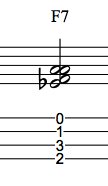
It contains: F A C Eb (1 3 5 b7)
There are 2 A’s because the fourth string fret 2 is the same pitch as the open A string.
Let me know if you have any questions. Thanks for pointing this out!
-
AuthorPosts