
Forum Replies Created
-
AuthorPosts
-
 AndrewKeymaster
Great suggestions guys, I added them to my request list 🙂
AndrewKeymasterHi Lisa, no exercise per se, but I can make a suggestion. The best advice I can offer is to be conscious of this every time you play. We should never have tension in our playing hands, but it is something I see a lot with beginners. And I think it’s because they are focused on so many other aspects of playing. This also extends to fretting too hard.
September 15, 2017 at 1:49 pm in reply to: The Accountability Thread – Participate in the September 2017 Member Challenge #13513AndrewKeymasterHi rillke, that piece is EP004 – 2 Chord Jam from our Concept Lessons series. Great playing, that would be a great song for the challenge!
AndrewKeymasterThanks for the feedback Phil! The songs that Steve is trying to tackle fall into levels 1 through 4. Those levels are not beginner-friendly. This is why I introduced the “beginner series” level. Songs in that category are beginner-friendly. For someone just starting out, the best place to start is our Beginner’s Course. There are 27 lessons in the course and it takes you from A to Z. It’s written to set you up for success and getting to the point where you can play your first songs.
Building a solid foundation in your playing is important before trying to jump into harder songs. Which brings up a point that I touched upon in a recent forum post. One of the most common questions I get asked is: Where to start? I’m planning to create what I’ll call: Learning Paths. Which will be guided step-by-step plans for where to start in regards to beginner, intermediate, and advanced players. It’s much needed as we currently have over 215 lessons. I’ll begin working on this project this coming week.
AndrewKeymasterYou may want to check out the Beginner’s Course too, there’s a lot of great content in it.
I’ll be focusing on adding more beginner tunes over the next few months. There will be two new ones coming in the next month for sure 🙂
September 13, 2017 at 11:13 pm in reply to: The Accountability Thread – Participate in the September 2017 Member Challenge #13498AndrewKeymasterSounds great Margo!
On my end, I finally got around to practicing what I initially set out to work on for this month’s challenge: Triplet picking. Here’s a short little video of the technique used in an upcoming country lesson: Tennessee Waltz. I opted to use a bit of free time and create a feel that started slow, peaked, and then declined. I think it sounds really cool and suits the ending of this song very well.
Btw, I’m really enjoying this technique, it’s a lot of fun! I’m looking forward to using it in future lessons too.
AndrewKeymasterHi Steve,
It sounds like you may be trying to tackle some songs that are currently above your playing ability. Now there’s nothing wrong with this and the advice that I usually offer is to give it a shot, even if it is beyond your playing ability. Because even if you don’t learn the entire piece, you’ll get better in the process.
Now on the flip side, your goal is to be able to play a song from start to finish and specifically a solo fingerstyle piece. This was the exact reason that we introduced Courses into the site. I wanted to be able to provide a foundation in technique and theory that would help you conquer the performance tunes. So if I was you, I would set aside some of your practice time to developing technique.
Start by working through our Fingerpicking Course. This will help your right hand with dexterity and help your left hand dive beyond chord based playing. I would couple that with taking a look at our Beginner Level songs. A great one to start with is “Aura Lee“. It’s got a great melody, it was used in an Elvis song, and it’s got great potential for being the first song you add to your repertoire. I’ve got two more beginner levels tunes coming out soon, one of which is the theme to The Addams Family.
Have you seen our September site member challenge? This month is perfect for you to participate in as it hits directly at what you are wanting to work on. Take a look at it and I hope you join the challenge. If you need any help with figuring out what to do, just let me know 🙂
Cheers,
Andrew
September 11, 2017 at 12:13 pm in reply to: The Accountability Thread – Participate in the September 2017 Member Challenge #13457AndrewKeymasterHi Mt, here is a short video with some tips and an exercise for hammer-ons and pull-offs. Let me know if you have any questions 🙂
If anyone else is new to this technique, be sure to check out this introduction lesson.
September 10, 2017 at 1:42 pm in reply to: The Accountability Thread – Participate in the September 2017 Member Challenge #13452AndrewKeymasterGlad you are feeling better Kay – I know all too much about that and constantly hear my PT in my head yelling at me to “Take breaks” 🙂 Great challenge, well thought out! Looking forward to seeing your progress!
AndrewKeymasterMy pleasure! If you ever need help on a lesson don’t hesitate to email me or post on our forum 🙂
AndrewKeymasterWelcome Rick, glad to have you onboard! To answer your question: Yes, all premium members can download/print out the tabs as a PDF document. All tabs also include standard notation.
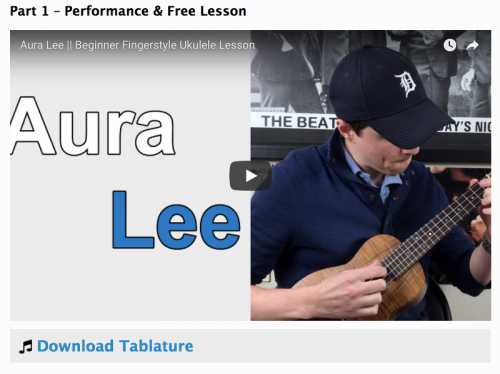
Underneath the part 1 performance/lesson video you will see a gray box that says “Download Tablature”. Click that link and you’ll be able to get the tabs 🙂 here’s a picture for your reference:
 September 8, 2017 at 6:57 pm in reply to: The Accountability Thread – Participate in the September 2017 Member Challenge #13441AndrewKeymaster
A lot of people fall into that routine Lynda (including I at times!). I think you have a great plan laid out. I would suggest to flesh out these 5 points in complete detail:
– Strumming – growing my strumming repertoire
– learning new songs that challenge me
– learning new chord inversions, that I can have at my finger tips (so to speak)
– practicing songs I know, and learn them by heart
– build a good repertoire of sing a long songsFor example the first topic, strumming, are you focusing on technique or rhythm? I like to dive “three deep” into topics. Meaning:
Strumming > develop rhythm > practice 5 strum patterns each using a different rhythm > apply strum patterns to songs
Hope this gives you some food for thought 🙂
—-
Glad to hear the finger is healing James. Looking forward to the video!
AndrewKeymasterHaha that’s awesome! We are writing a Bossa Nova piece for concept lesson EP008. Its got a sweet sounding latin drum track and uses some great jazzy uke chords. We’ll prob roll this lesson out in late October as there are a lot of tunes in que before it 🙂
September 7, 2017 at 6:03 pm in reply to: The Accountability Thread – Participate in the September 2017 Member Challenge #13416AndrewKeymasterGlad I could help Vida. Keep working at it! Perhaps something else could be done to your ukulele. Email Mike at Uke Republic, he should know what to do 🙂
September 6, 2017 at 4:23 pm in reply to: The Accountability Thread – Participate in the September 2017 Member Challenge #13413AndrewKeymasterWow Tessa! I hope it passes fast. I’ve driven through those before and they are awful!
Vida, the reason you are having difficulty with this technique is because you are attacking, or hitting, with too much force. Try to tone it down about 90%. So if you watch the video again that I had emailed you, and I’ll paste it below, skip to 1:19. Notice how my attack is much lighter than yours. It’s the same force you would apply if you were sitting at a desk and were so bored that you were tapping your finger on the desk. So if you lighten up and hit directly over the second metal fret, you should be able to create the harmonic.
I would also encourage you to continue doing the plucked harmonics. That is another great technique and is very useful to have in your arsenal. Let me know how it goes 🙂
-
AuthorPosts