
Forum Replies Created
-
AuthorPosts
-
 AndrewKeymaster
Lemme know if this makes sense.
AndrewKeymasterAwesome story! I look forward to hearing you play and hope you join one of our monthly challenges 🙂
AndrewKeymasterHard to comment without being able to play it (i.e. if it needs a setup/adjustment). Maybe take it to a shop that does setups to see if they can help? In the meantime I’d play your other Uke.
AndrewKeymasterWe have a lesson on increasing left hand reach 🙂 Remember, take it slow. It takes months to see results.
February 25, 2019 at 11:22 am in reply to: Participate in the February 2019 Member Challenge – Music Reading Course! #25336AndrewKeymaster@wongbrown – Mac and PC comes with a free editor (iMovie or Windows Movie Maker). You can use that editor, but will need to google a tutorial on how to do split screen.
February 24, 2019 at 9:05 pm in reply to: Participate in the February 2019 Member Challenge – Music Reading Course! #25312AndrewKeymasterlyndallk – Brilliant performance! The only critique I have is to watch out on the dotted halfs (bar before melody B and C), as you cut it short.
morrieuke1 – Aww, I love it Mike! That was a perfect performance & your daughter’s ballet moves rock! Thanks so much for the kind words, really means a lot.
On thing I want to point one for those that are watching his performance/reading this feedback, notice how he taps along as he plays. This is such a great thing to do to help keep in time. If you’ve never tried it before, start with the metronome on as you tap along before trying without it.
incywincy – love that you played with the backing track and metronome! Your timing sounds great and your form looks spot on. Keep up the great work!
laurasil – excellent playing! Timing and note clarity sounds great, keep up the great work!
planetfink – Right on, that was awesome! So here’s the thing with speed, it comes in time. But, it sounds like you are really close to being able to play at 100%. The best way to get there, or I should say the most efficient way, is to work it up to speed by building muscle memory and focusing on note clarity. So drop it down to 75 or 80%, start there & focus on those two aspects; before you know it you’ll be at 100%.
annefgodfrey – you are rocking this month! Check out the advice I left above for lyndallk. Those dotted half notes can be tricky and often times we want to rush them. One tip, when you’re practicing, count out the rhythm as you sustain that note. It will help ensure that it lasts the entire length (3 beats).
coffeemug – Glad you are enjoying learning to read. 🙂 So your playing sounds fine, but it was really loose with the timing. One thing that helps is tapping along just like morrieuke1 did. But the best way to ensure that we keep in time is to play alongside the metronome or with the on-screen tab viewer. So that would be my focus for you as you continue throughout the course.
lizzieswolf – Really cool that you did three of the tunes! So let me start by talking about the first two. So your playing sounds great, but one thing that you tend to do is rush the beat. Here’s a video that shows what that means:
The thing with Ode To Joy, is that it’s a song that really is meant to be played on the beat, with the notes sustaining into each other. So what you want to do is go back and play along with the on-screen tab viewer. It will act as a guide and help keep you on the beat.
As far as the last (third) song, keep practicing it. Break it into sections, such as, 4 bars at a time and play along with the tab player. That one is definitely the trickiest out of the three.
holly1 – Thanks for joining the challenge, Holly! Your playing & timing sounds great, so what I would work on is giving the picado technique a shot. It’s super useful and definitely worth the effort to learn. 🙂
AndrewKeymasterThis is really cool, 17 was the last I could hear.
AndrewKeymasterWelcome, Kip! I’m always around if you need help on the lessons 🙂
AndrewKeymasterOk, now that I’ve had lunch I can think again, LOL. So let me try to answer this again:
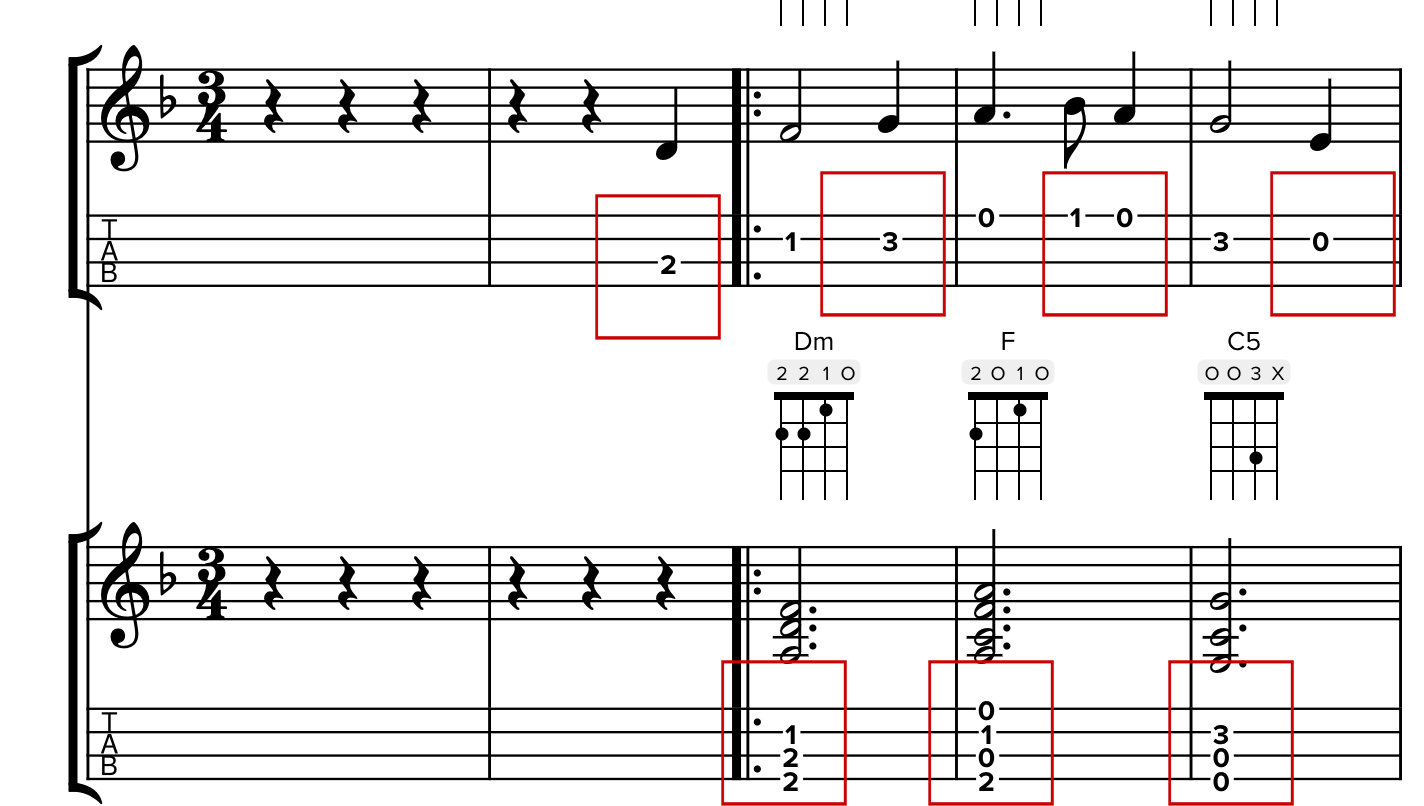
I forgot how I wrote the harmony, but it looks like I made it easy to combine everything. I put a red box in the order to play it. Every chord highlights the melody, but some chords may just be 2 notes. So not really a chord, but a double stop. Anyways, you apply the above method to the entire piece.
AndrewKeymasterHi Jerry, actually the easiest way to tackle this would be to reference @planetfink ‘s performance. Compare what you’ve got to hers and if you’re still stuck let me know.
AndrewKeymasterWelcome, Holly! Glad you found us and believe me, there’s a reason I don’t sing on our videos haha 🙂
AndrewKeymasterHi Dea, I sent you an email a couple hours ago. It looks like you paid via eCheck. Those take about 5 days to clear. Your membership should start on 2/25 and you’ll receive an auto-email from us confirming that. Sorry for the delay, unfortunately that payment method takes time to clear. If you have any questions, you can email me direct.
February 19, 2019 at 1:16 pm in reply to: Participate in the February 2019 Member Challenge – Music Reading Course! #25194AndrewKeymasterRickey, ideally you want to read and play. Though, the more you practice, eventually you’ll just have it memorized.
Correct, C would be an octave. G would be interchangeable if you were playing a high G, but the course isn’t written for high G, it’s intended for low G. You will learn the lower pitched C in the unit, natural notes on the C string. For now, keep focused on strings 1 and 2.
AndrewKeymasterAwesome! Major props for tackling this one, it’s a toughie! Keep rockin! 🙂
February 18, 2019 at 10:09 pm in reply to: Participate in the February 2019 Member Challenge – Music Reading Course! #25189AndrewKeymasterayin08 – well done! Great job on the timing too. The only suggestion I have for you is to scoot your right hand back just a little bit. Check out this guide to see where we recommend hand placement. And keep up the great work! 🙂
cncamacho – great job and glad to hear you enjoy the Low G content! What I would turn your focus on when practicing is timing. Now that’s not to say that your timing is bad, because it’s not, it’s pretty good; but it can be a bit tighter. When you practice try to always play along with the metronome or the on-screen tab viewer. That’s the best way to strengthen it.
annefgodfrey – you are rocking it so far! Excellent job on the picado technique and your plucking attack sounds great – strong, yet warm. I know we talked about that and I can see you’ve been working on it, that’s awesome! Keep at it and I look forward to hearing where you end up. Don’t worry about playing the entire song, if you can get the next section or two as strong as this one, that’s what really matters 🙂
smudge – Alright, so let’s talk about the chord melody first – it was awesome and I really dig the changes you through in there! Your timing is excellent too.
So here’s the thing with the first part (single note melody), you started out really strong and then had a fumble in the third melody, but you never quite recovered. So if you listen back you hear that you continue playing, but if you tap along, you’ll notice that the beat was lost. So if this was to happen and you were playing in an ensemble, what you would need to do is fall out and come back in. The key here is to always know where the music is relative to the beat/bar. Now as a solo performer, you would want to keep going and play through your mistakes, but again always know where the music is relative to the beat/bar.
lynettejd – great job! I’d actually recommend the same advice I left above for cncamacho for you. The only thing to I want to suggest is to try a lighter pluck attack. A lighter attack will produce a softer, sweeter tone. But overall great job, keep up the good work!
-
AuthorPosts