Andrew

Forum Replies Created

Viewing 15 posts - 2,896 through 2,910 (of 4,159 total)
  • Author
    Posts
  • Andrew
    Keymaster

    brettboy – I love the deep tone of the baritone. Honestly, this is one of your best performances that I’ve heard. So much feel and emotion in your playing. Absolutely lovely and I especially like your interpretation of the last melody.

    cyukug – Here is a quick video with one tip that will help you get a cleaner sound when transitioning from chords to single notes. Here is the lesson I referenced.

    nthibode – Brilliant performance! Your uke playing is beautiful. Keep working at the high note, check out the tips Katie left about it here.

    in reply to: Uke and Piano Duet Music #26050
    Andrew
    Keymaster

    Yes, I can def add that. I’ll respond on this post when it’s up πŸ™‚

    Thx for the feedback, I’ll remember to add a solo uke play-along track for every duet/band song we do from now on.

    in reply to: Uke and Piano Duet Music #26047
    Andrew
    Keymaster

    Unfortunately, no. But, the chords are listed above the ukulele tab/notation. πŸ™‚

    in reply to: My first original song ! #26041
    Andrew
    Keymaster

    Very beautiful, keep writing! You have a great talent πŸ™‚

    in reply to: Hello from California #26040
    Andrew
    Keymaster

    Welcome, Mollie! Happy you found us and I look forward to hearing you play πŸ™‚

    in reply to: A Special Request for Anne Godfrey #26013
    Andrew
    Keymaster

    Anne, my heart weighs heavy for you. Your family will be in my prayers.

    Andrew
    Keymaster

    @hotmilktea – Here is what Katie said πŸ™‚

    Great performance! Singing and playing the fingerpicking part can be difficult due to the extra embellishments that don’t follow the melody. Because singing and playing at the same time can be difficult to navigate, so here are few tips that I give my students in order for them improve. It is common to forget to support your singing as you play because your concentration is divided. As you continue to practice, be mindful of your breath and make sure you are breathing deeply from your diaphragm. Focus on filling the bottom part of your lungs first, the sides expanding the ribcage, and then the very top. Keep your shoulders down and relaxed.

    From there, over annunciate your consonants and open up on the vowel. This will help with your breath support as well because your air will not escape out of your mouth as quickly leaving more air in your lungs to support your voice.

    As you are singing, imagine the air coming up and out of the top of your head like a dolphin instead of out of your mouth. That helps you not to over sing and use less air. Place your hand over your mouth and sing β€œgloria” like you normally would. You will probably feel lots of hot air against your hand. Now try it again but this time think about the air coming out of the top of your head instead of your mouth. You’ll feel less hot air hitting your hand as you sing. People have a tendency to imagine their air coming straight out of their mouths while singing and use too much air. That cuts their phrases short. It also might help imagining a candle in front of you as you sing. The goal is to imagine the flame barely flickering in front of your lips while you sing. I wish I could make video for you because this would make more sense, but I hope that this helped. Let me know if you need anything else.

    in reply to: Birthday Present #25899
    Andrew
    Keymaster

    Oh, wow that’s nice!

    Andrew
    Keymaster

    laurasil – Beautiful playing! Here is a video on some ideas to vary your strum attack to produce timbres. And here is the lesson on the mechanics behind the “flick” strum I mentioned.

    in reply to: A Special Request for Anne Godfrey #25887
    Andrew
    Keymaster

    Hi guys, we released the lesson today! πŸ™‚ All of the songs Anne suggested where awesome, but in the end we chose, “When I’m Sixty Four” by The Beatles because it has such a fun, playful melody!

    Hope you enjoy it, Anne!

    Andrew
    Keymaster

    erino7 – Courtney, that was amazing! It was an honor sharing that in our email and social last week πŸ™‚ I also sent it to Katie, she loved it!

    So there’s only one thing that kind of stuck out a little bit to me, in terms of me offering feedback. So you used a 3 finger approach for fingerpicking, which is totally cool, but if you watch the video, notice how your ring finger sticks straight out. Try to keep it curved in (like your other fingers; and as you can see in the photo). This way it’s always in position to be engaged, which will be ideal for when you tackle a 4 finger pieces.

    null

    deadbuggy – That was awesome, Sara! You aced the first melody, clean playing and a great feel/timing. So I’d turn your focus towards the second melody. Take it a little bit slower and work it up to speed. But overall, awesome job and the tone of your uke is beautiful!

    becky7777 – Beautiful playing! I think your focus should be on transitions. So when I listen back, I hear quite a few pauses between phrases. Target these areas and practice transitioning from one phrase to the next. But bravo on this, keep up the great work!

    gstriph – Here is a video with a couple tips on timing for you πŸ™‚

    stianukulele – Wow! That was beautiful and I love the bass! Very well done πŸ™‚

    stinyuke – Bravo to you and Robin! Absolutely gorgeous rendition. I will definitely be sharing this in our email on Friday πŸ™‚

    casadot349 – Bravo! Here are 2 lessons I want you to check out. And I made a short video for you too πŸ™‚

    1) Proper Left Hand Form
    2) Proper Right Hand Form

    cncamacho – Well done! So for the Chord Melody intro, I’d focus on getting the transitions from one phrase to the next, as well as the timing, a little smoother. So what you want to do is just slow it down and play along with either the metronome or the tab player. Work on one or two bars at a time.

    And I know you know exactly how to practice because the finger-picked vocal part was excellent. Great timing in that section! So a little bit more work for the first part and you’ll be rocking it!

    hotmilktea – Very impressive! Playing wise, that rocked! I don’t have any suggestions for improvement there. Vocal wise, it was a bit pitchy on those high notes. I don’t sing, so I’m not really sure what you should be working on other than suggesting ear training. But I’ll send this to Katie and I’m sure she can provide something more constructive for you.

    in reply to: Hello all. I am from the Czech Republic. #25865
    Andrew
    Keymaster

    Welcome, bohous!

    in reply to: Harp-Ukulele duets #25856
    Andrew
    Keymaster

    Wow! So beautiful πŸ™‚

    in reply to: New Reading Standard Notation #25817
    Andrew
    Keymaster

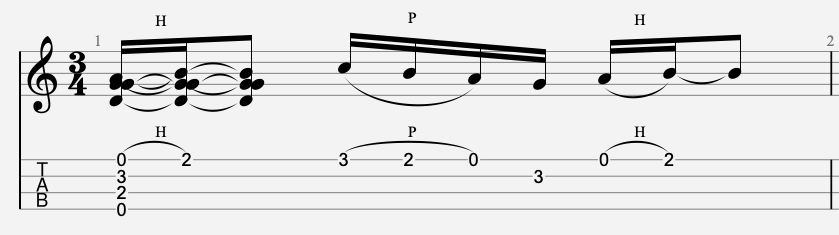
    So the harmony is only meant for accompaniment and is not taught in the course. The course only covers the melody.

    The melody note on beat 1 in bar 2 is a G note, played at the 3rd fret. The harmony chord (G7) also contains the note G, but one octave lower, which you will learn later in the course in: Notes on the G String.

    The notes are as follows:

    5 (D – 1)
    7 (B – 2)
    5 (F – 3)
    0 (G – 4)

    Which make up a G7 chord:

    G (1) B (3) D (5) F (b7)

    in reply to: New Reading Standard Notation #25813
    Andrew
    Keymaster

    Ahh, yes you are reading it backwards.

    0575 – string 4 to 1. πŸ™‚

    As you fret chords, work your way from 4 to 1.

Viewing 15 posts - 2,896 through 2,910 (of 4,159 total)