
Forum Replies Created
-
AuthorPosts
-
 katazumiriParticipant
This time it has nothing to do with cup beat.
While the piece (Duetto buffo di due gatti) is typically attributed to Gioachino Rossini, it was not actually written by him, but is instead a compilation written in 1825 that draws principally on his 1816 opera Otello.
😸😸
August 28, 2024 at 12:30 pm in reply to: Participate in the August 2024 Member Challenge: TV Themes! #63468katazumiriParticipant
@The_Bumble_Bard Meow, meow, meow 😸😸
It made me think of “Duetto buffo di due gatti” (Italian for “Humorous Duet for Two Cats”).Have you ever seen this? If not, I’ll leave the version I like in the “cup beat” thread.
katazumiriParticipantThese two songs were constantly playing on the radio. And despite the fact that the songs are different, in some heads they successfully merged into one, so that a hybrid of “Modern Jovi” was created.
katazumiriParticipantAnd in Europe at that time Modern Talking were popular with the song You’re My Heart, You’re My Soul.
katazumiriParticipantThis is not an isolated case when one part of a song can be replaced by another. Maybe you know Bon Jovi and his song Livin’ On A Prayer? This song was popular in the late 80s.
katazumiriParticipantI haven’t seen the TV series “Friends”. I liked what Ashley did, but I was wondering what the original version of the song sounded like. When I was looking for the original, YouTube offered me a cover version of “Eastern Duo”. I liked their idea too.
And now let’s get back to your question: “Why did you choose to modify the beat?”.
We have two different songs, with different melodies, with different chords and (oh miracle) with two different percussion parts. I didn’t change Anna’s part, I’ve never played it (yet)…Or did you notice that what I did doesn’t look like the “Eastern Duo” version? I didn’t have to copy 100%. I borrowed the idea.
As I said before, Anna´s “cup beat” can be used in «I´ll be there for you». If someone already knows Anna’s «cup beat», they can play it!
-
This reply was modified 2 years, 1 month ago by
 katazumiri.
-
This reply was modified 2 years, 1 month ago by katazumiri.
-
This reply was modified 2 years, 1 month ago by katazumiri.
August 22, 2024 at 3:09 pm in reply to: Participate in the August 2024 Member Challenge: TV Themes! #63340katazumiriParticipant@the_bumble_bard I’m very pleased that you liked it.
There are a few „yes and no“ about the “cup beat”…
No: the “cup beat” is not the same as in the film with Anna Kendrik.
Yes: both songs are in 4/4.
Yes: both “cup beats” consist of 2 bars.
No: the rhythmic pattern of the first measure is not the same (see attachment).
Yes: the rhythmic pattern of the second measure is the same.
No: the movements of the hands and the cup in the second measure are not the same.
Yes: Either of these two “cup beats” will work with either of these two songs.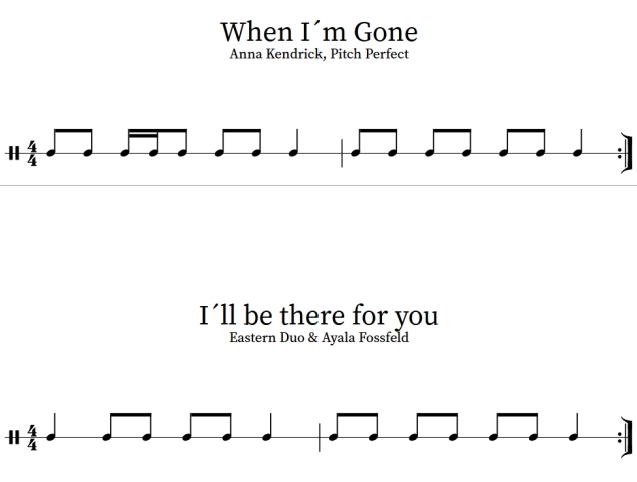
Cup-beat
@leb397 and @Andrew Thank you very much!-
This reply was modified 2 years, 1 month ago by katazumiri.
August 20, 2024 at 5:24 pm in reply to: Participate in the August 2024 Member Challenge: TV Themes! #63246katazumiriParticipantHello everyone!
Here is my attempt with – “I’ll Be There for You”.
I didn’t manage to do it in 53 seconds, but the number of bars stayed the same 🙂I liked the cover version by Eastern Duo Feat. Ayala Fossfeld; I borrowed some ideas from there.
Have a nice day!
katazumiriParticipantI’m glad you liked it. ☺
Johan believes that Piazzolla’s music is very difficult for those who come to his tango evenings. This is the most important limitation from his point of view.
At the end of the discussion, which dragged on and never ended, he said that in principle he did not like Piazzolla. This is another important limiting factor. This factor influences the decisions Johan makes.The dancers from the second and last post are professionals who like Piazzolla.
Tango evenings are often attended by beginners or “eternal beginners” (dancers with low skill levels), some of them have no idea who Piazzolla is and that they are dancing “wrong”. But Johan understands this.You’re right: the extra bit is confusing. Johan said that “Take Five” is simpler than Piazzolla’s music. There are many details in Piazzolla’s music that are confusing.☺
katazumiriParticipantLet’s return to Piazzolla. It turns out that from Jochen’s point of view, Piazzolla’s music is not danceable under certain conditions. And if you go beyond the limiting boundaries, then you can dance.
Finally, Piazzolla´s music interpreted by step dancers. And again it’s Esсualo.
katazumiriParticipantAnd here is an interpretation in the style of traditional Japanese dance.
I just find it fascinating.
katazumiriParticipantJochen teaches how to dance tango to traditional tango music, neo tango and non-tango. He also believes that it is impossible to dance tango to, for example, “Take Five.” He says that his students usually “don’t hear” 5/4, and those who do can’t translate it into dance. Tango is usually in 2/4 or 4/4 time.
“Take Five” is a jazz standard, so jazz dancers can probably handle it without any problems. I was interested in how non-jazz dancers interpret this dance.
Here we see salsa dancers. Salsa is usually in 4/4 time, so salsa dancers have much the same problems as tango dancers, namely what to do with the extra 1/4.
I like what they did.
katazumiriParticipantThe problem is that at tango evenings where there are a lot of dancers and limited space, there are rules that it is advisable to follow, for example, dance only forward (the space behind you belongs to other dancers), your feet always remain on the floor. Otherwise, the risk of injury will increase. And here we can see an example of how to dance in a confined space
Unfortunately, not all dancers follow these rules. And Piazzolla’s music “provokes” people to disregard safety rules.
katazumiriParticipantNow let’s see what a choreographed dance to Piazzolla’s music looks like. In this case it is Escualo.
The description under the video says: „… we combine the tango technique with disciplines such as ballet, jazz and we add tricks to make our performance even more attractive „
July 9, 2024 at 5:43 pm in reply to: Participate in the July 2024 Member Challenge – Original Music! #62292katazumiriParticipant@The_Bumble_Bard Thank you ☺
People who can or love to dance can also dance to this tune if it suits their preferences.
It’s funny, I recently came across a discussion of people who love to dance tango. They discussed the topic: is it possible to dance to the tango of Astor Piazzolla? The opinions were diametrically opposed. Some were confident that it was possible and necessary. Others believed that Piazzolla only needs to be listened to, and that it is impossible to dance to his music. 🤔
I wouldn’t say that the chord progression was randomly generated. And Dave (the owner of the page) writes:”Following on from my tool to help you find ukulele chords that sound great together. If you’ve got an amazing chord progression that you’d like to contribute, I’m all ears. Drop me an email with the chords in – I’ll give it a play and if I like it, I’ll add it in!”
It was a chord progression that was carefully selected and stored in a database. But progressions are issued randomly from the database, so if you liked something, it’s better to write it down right away, it’s not known when you will see the same progression again. ☺
Dm C Bb A can also be written as i VII VI V
This progression reminded me of something, but I couldn’t remember what exactly.
Now I looked into the „Hooktheory“ and it turned out that this is how „Carol of The Bells“ begins. https://www.hooktheory.com/trends#key=Rel&scale=minor&path=1.7.6.J5
-
This reply was modified 2 years, 1 month ago by
-
AuthorPosts